One Breast Producing Less Milk Suddenly:
Causes and How to Fix It
You noticed it mid-session — one side is barely giving anything while the other overflows. Here’s everything you need to know, straight from a nurse and mom who’s lived it.

It is completely normal for one breast to suddenly produce less milk than the other. This can happen at any stage — especially at 2 or 3 months postpartum — due to differences in breast anatomy, baby’s feeding preference, hormonal shifts, blocked ducts, or pumping technique. The good news? In most cases, it’s fixable with targeted strategies.
I remember the moment like it was yesterday. My baby girl was about 10 weeks old, and I was sitting in my nursing chair at 2 a.m., pump flanges attached, watching my left side fill the bottle while the right side produced… almost nothing. A thin stream. Maybe half an ounce. My immediate thought was something is wrong with me.
As a registered nurse, I knew enough to not panic — but as a new mom, my heart still sank. If you’re reading this right now at midnight wondering why one breast is producing less milk suddenly, I want you to know: you are not broken. Your body is not failing you. And this guide is going to walk you through every real reason this happens, and exactly what I did (and what actually works) to fix it.
Is It Normal for One Breast to Produce Less Milk?
Yes — and here’s the part that surprises most moms: your two breasts have never been identical on the inside. They’re like twins, not clones. Research from the Australian Breastfeeding Association confirms that each breast operates somewhat independently, responding separately to stimulation, and that it’s entirely common to get different volumes from each side.
In fact, studies suggest the right breast tends to produce slightly more milk for most women — though this varies widely from person to person. So if you find that one breast produces more milk than the other when pumping, you’re in the overwhelming majority of nursing moms, not the exception.
Milk production is entirely driven by supply and demand. Each breast maintains its own local supply system. This means changes in stimulation, feeding frequency, or even stress can affect one breast more than the other — sometimes very suddenly. This is physiology, not failure.
7 Real Reasons One Breast Is Suddenly Producing Less Milk
Let’s go beyond the surface-level answers. Here are the real, clinically-grounded causes I’ve seen both in practice and in my own experience:
Your Baby Has a Side Preference
This is the most common culprit. When babies latch more easily or feed longer on one side, that breast gets more stimulation and ramps up production — while the less-favored side slows down in response to lower demand. Supply follows demand, always.
Differences in Breast Anatomy
One breast may simply have more glandular (milk-producing) tissue, larger or more numerous milk ducts, or a faster let-down reflex than the other. These anatomical differences are structural — you were born with them — and they show up more clearly once lactation is established.
Blocked Milk Duct
A plugged duct can restrict milk flow in one breast significantly and seem to happen overnight. You might feel a small, tender lump, and notice that side suddenly drops in output. If left unaddressed, a blocked duct can progress to mastitis, so early action matters.
Hormone Fluctuations
Hormones like prolactin and oxytocin govern milk production. When they shift — due to your menstrual cycle returning, stress, sleep deprivation, or starting hormonal birth control — one breast may respond differently than the other, leading to a sudden, seemingly unexplained dip.
Poor Pump Flange Fit on One Side
If your pump flange (the funnel-shaped cup) is the wrong size for one nipple, it won’t extract milk efficiently from that breast. You might be pumping equally from both sides, but getting drastically different results. This is one of the most commonly overlooked causes — and one of the easiest to fix.
Previous Surgery or Injury
If you’ve had a biopsy, breast reduction, augmentation, or even an injury to one breast, the scar tissue or altered duct structure can impact milk flow on that side specifically. This may have always been the case but becomes more noticeable as supply regulates.
One Breast Producing Less Milk Suddenly at 2 Months
If you’ve noticed a sudden drop in output from one side around the 6–9 week mark, you’re in very good company. Here’s what’s happening biologically: in the early postpartum weeks, your body produces milk based on hormonal cues — it’s essentially flooding the zone with “insurance milk.” But around 6–8 weeks, milk production starts transitioning to a demand-based system.
What this means in practice: your breasts begin calibrating to exactly what your baby needs. During this shift, if your baby has been slightly favoring one breast — even subtly — that preference gets amplified. The preferred breast stays well-stimulated while the other starts pulling back. This is why moms often describe their less-productive side as a “slacker boob” appearing suddenly out of nowhere at 2 months.
- Your baby is still gaining weight steadily and meeting growth milestones
- Baby has at least 6 wet diapers per day and regular bowel movements
- Your combined output from both breasts is still meeting baby’s needs
- Breasts feel softer overall — this is normal supply regulation, not depletion
- No pain, redness, or fever on the lower-output side
One Breast Producing Less Milk Suddenly at 3 Months
The 3-month mark is one of the most confusing and emotionally charged moments in any breastfeeding journey. I hear from so many moms who are convinced they’re “losing their milk” at this stage — and almost always, what they’re actually experiencing is supply regulation, not supply loss.
Here’s the science: around 10–14 weeks postpartum, prolactin levels naturally stabilize. Your body has now learned your baby’s patterns, and milk production switches from being hormone-driven to being purely demand-driven. Your breasts stop feeling as full. Pumping output may drop slightly. And the difference between your two sides can become much more noticeable.
For moms experiencing one breast producing less milk suddenly at 3 months, this is almost always the culprit — not a medical crisis. Your body is actually becoming more efficient, not less capable. That said, the 3-month period is also when many moms return to work and introduce pumping into their routine for the first time, which can create real supply imbalances if one side is pumped less frequently or with a poor flange fit.
When my son was 3 months old, my right side went from producing 3 oz per session to barely 1.5 oz — seemingly overnight. I panicked, ate oatmeal for a week straight, and drank what felt like a bathtub of water. What actually fixed it? I checked my flange size (it was too large on the right), swapped to the correct size, and started every session on the right side first. Within 4 days, I was back to even output on both sides.
One Breast Producing Less Milk Suddenly When Pumping
When you’re exclusively pumping or combination feeding, noticing that one breast produces more milk than the other when pumping is extremely common. Over 90% of pumping moms report consistent differences between sides. But a sudden drop — where output from one side decreases noticeably compared to your own baseline — deserves attention.
Here are the pumping-specific reasons this happens:
How to Fix It: 8 Proven Strategies That Actually Work
Here’s my nurse-approved, mama-tested game plan for rebalancing supply when one breast has dropped behind. Start with the quick checks and work your way through:
-
1
Always Start on the Lower-Output Side
Begin every nursing session or pumping session with your “slacker” breast. Your let-down reflex is strongest at the beginning of a session, and baby’s hunger drive is highest. Give that side first access to both of those advantages.
-
2
Check Your Flange Size Immediately
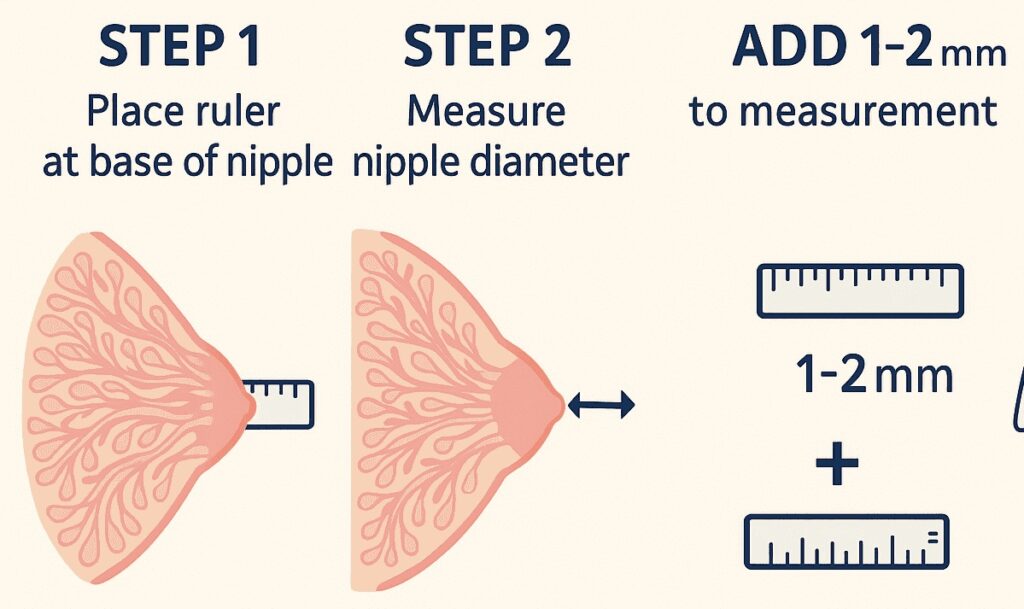
This is non-negotiable if you’re pumping. Measure both nipples separately — they can actually be different sizes. A correctly-sized flange should have 1–3mm of space around your nipple without pulling in significant areola tissue. Read our full breast pump flange sizing guide for step-by-step instructions.
-
3
Add a Solo Pumping Session for the Slacker Side
Once a day, pump only on the lower-producing breast for 10–15 minutes. Place a milk catcher or breast pad on your other side to catch the let-down that will happen. This targeted stimulation demands more from that breast specifically, and your body responds by increasing supply there.
-
4
Try Power Pumping on the Lower Side
Power pumping mimics cluster feeding and is one of the most effective tools for increasing supply on a specific side. Pump 20 minutes on, 10 minutes off, 10 minutes on, 10 minutes off — all on the slacker breast — once a day for 3–5 days. Learn more about how pumping frequency impacts supply to optimize your approach.
-
5
Use Breast Compressions While Pumping
During your pumping session on the lower side, use your hand to massage and compress the breast in a sweeping motion toward the nipple. This physically moves milk through the ducts and often triggers additional let-downs, significantly increasing output per session.
-
6
Apply Warmth Before Pumping
A warm compress or warm shower before pumping on the slacker side helps dilate milk ducts and encourage let-down. If you have a suspected blocked duct, warmth + massage + frequent pumping is the first-line treatment.
-
7
Pump Longer on the Slacker Side
If you’re doing bilateral pumping, consider adding 5–10 minutes of single-side pumping on the lower-producing breast after each session. The continued stimulation after the initial let-down can trigger a second let-down on that side and train your body to produce more there over time.
-
8
Address Stress, Sleep & Hydration
Cortisol — your stress hormone — actively inhibits oxytocin, which is responsible for your milk let-down. If your slacker breast is also the side you’re tensing up on, or if you’re running on no sleep and minimal water, those systemic factors can suppress output on your more vulnerable side first. Drink at least 2.5L of water daily and explore proven strategies to increase milk supply when pumping.
Quick Reference: Causes vs. Likelihood of Fixing It
| Cause | Common Timing | Usually Fixable? | First Step |
|---|---|---|---|
| Baby’s side preference | Any stage | Yes | Start sessions on that side first |
| Wrong flange size | Any stage (pumping) | Yes | Remeasure both nipples separately |
| Supply regulation at 3 months | 10–14 weeks | Yes | Maintain demand; don’t supplement formula |
| Blocked milk duct | Any stage | Yes | Warmth + massage + frequent feeding |
| Anatomical differences | Always present | Partial | Maximize stimulation on slacker side |
| Hormonal birth control | 6-week check-up onward | Yes | Discuss progestin-only options with provider |
| Previous breast surgery | Always present | Partial | Work with an IBCLC for personalized plan |
| Stress / sleep deprivation | Any stage | Yes | Rest, hydration, cortisol reduction strategies |
| Thyroid or hormonal disorder | Any stage | With treatment | Lab work with your healthcare provider |
What Not to Do When One Breast Drops in Supply
- Don’t neglect the slacker side altogether. The less you pump or nurse on that breast, the more supply will decline — it’s a self-reinforcing cycle that’s hard to reverse the longer it continues.
- Don’t overcompensate on the “good” side. Pumping aggressively on your high-output breast while ignoring the lower one will widen the gap, not close it.
- Don’t assume it’s over. A sudden drop in one breast does not mean you’re “drying up.” In most cases, targeted intervention reverses it within days to two weeks.
- Don’t start supplementing with formula on that side without trying to fix the root cause first. Supplementing reduces demand, which further reduces supply — see why pumping consistency matters for supply.
- Don’t ignore pain or fever. If your low-output breast is painful, red, or warm to the touch and you have a fever, this is mastitis — and you need to contact your healthcare provider the same day.
When to Actually Worry: Red Flags to Watch For
Most of the time, uneven supply is a management issue, not a medical emergency. But there are situations where I’d encourage you to call your provider or a certified lactation consultant (IBCLC) sooner rather than later:
A hard, painful lump in the low-output breast accompanied by fever (possible mastitis) · Sudden drastic drop in output from both breasts (could indicate systemic hormonal issues) · Breast skin that appears dimpled, thickened, or has an orange-peel texture · Baby is losing weight or has fewer than 6 wet diapers per day · You’ve had thyroid issues, PCOS, or insulin resistance and suspect these may be affecting supply.
It’s also worth connecting with an IBCLC if you’ve been trying the strategies above for 2+ weeks and aren’t seeing any improvement. A lactation consultant can assess your latch, your pump setup, your anatomy, and your overall feeding plan in a way that a general article simply cannot replicate.
Combining Breastfeeding and Pumping to Balance Supply
One of the most effective strategies for moms dealing with supply imbalance is combining breastfeeding at the breast with strategic pumping — especially when you’re away from baby or building a freezer stash. This approach lets you prioritize the slacker breast at nursing sessions while maintaining overall supply efficiently.
If you’re navigating this balance, I highly recommend reading my guide on how to combine breastfeeding and pumping — it walks through exactly how to structure your day to maximize output from both sides without burning yourself out. And if you’re wondering about timing, check out how soon you can breastfeed after pumping, because the timing matters more than most moms realize.
Frequently Asked Questions
Here are the most common questions I get from moms dealing with one breast producing less milk suddenly — answered honestly, without the fluff:
You’re Doing Better Than You Think, Mama
One breast producing less milk suddenly can feel like a crisis in the middle of an already exhausting season of life. But I want you to hear this clearly: it is almost never a sign that your body has failed or that breastfeeding is over.
Your body is responsive, adaptive, and remarkably capable of rebalancing — especially when you understand what’s actually happening and take targeted steps. Whether you’re 2 months in, 3 months in, or well beyond that, there is almost always something you can do to improve the situation.
And if you’ve tried everything and one breast just isn’t coming back? That’s okay too. You can feed a healthy, thriving baby from one breast. Many moms do. What matters most is that you and your baby are well — and you clearly care deeply about that, or you wouldn’t be here reading this at what is probably an unreasonable hour of the night. 💕
Written by Charlotte Rose, RN · Breast Pumps Hub · Read more from Charlotte →
📖 Found this helpful? You might also love: How to Increase Milk Supply When Pumping — our most comprehensive guide on the topic.